
January 2, 2026
31 minute learn
The sourcing work behind Aviary’s 2025 season was impressed by this inquiry; the analysis and work required to publish this piece was made attainable by means of the assist of Aviary 2025 season reservation holders.
The incursion started at two o’clock within the morning because the city slept. The eighty rebels obscured their identities with ski masks and the darkness of night time as they entered the agricultural cooperative of El Porvenir, 45 kilometers exterior of Tingo Maria.
A month earlier, cooperative members reported that unknown people had approached them within the close by city of Rio Azul, inquiring concerning the identities of the cooperative’s leaders and demanding fee of 30 million soles to make sure the security of the cooperative and its members. The cooperative, dismissing the seriousness of the risk, declined to pay; every week later, 2,500 sq. meters of tea plantings have been burned.
By the early Eighties, Sendero Luminoso (SL, or “The Shining Path”) had constructed sufficient assist to develop its actions by means of the Andean highlands towards Tingo Maria, aligning themselves with coca farmers and making Tingo Maria a hub for its actions within the narco commerce. The insurgency’s rising use of violence—reprisal killings of indigenous folks, assassination of police and native officers, and sabotage of infrastructure—intimidated authorities officers into resigning; those that remained in workplace responded with complicity or ambivalence. This, mixed with early populist rhetoric focusing on the federal government for widespread perceived neglect of the agricultural, agrarian communities, allowed the Shining Path to proceed to realize affect, credibility and assist, enabling the scope and brutality of their operations to develop. In August 1984, the New York Instances reported that “Since final October, when the guerillas first appeared within the space, the police estimate they’ve recruited 1,500 to 2,000 folks within the valley.”
Within the early days of the motion, the rebels would have armed themselves with knives and machetes forward of their raids, splitting into contingents once they arrived at their vacation spot, one to cease visitors, one to steal provides on the town, and one to rob the closest police precinct within the hope of gathering armament they might use of their assault. After looting the armory, they’d go away the station in flames, bombing it utilizing “quesos rusos”—improvised plastic explosives: The information reported that “Working in bands of as much as 100 younger women and men, they’ve dynamited 10 of the 13 police stations within the area, attacked banks and killed 19 policemen.”
However by February 13, 1986, there was no want for the detour: the rebels fanned out by means of El Porvenir armed with rifles, revolvers and machine weapons, waking the 5,000 members and their households at gunpoint to drive them exterior their houses after which set them ablaze. With the cooperative watching, the Sendero Luminoso militants completed their job: they stormed the executive places of work of the cooperative, burning accounting paperwork, destroying furnishings and tools used for hulling and cleansing espresso—after which, with the cooperative in cinders, some seven hours after the assault started, they burned the espresso fields.
Sections
Introduction
Timeline of key occasions in Peru
A stranger in a wierd land
A short historical past of Peruvian espresso
Inca Gesha, or ought to we are saying SL-9?
The founding of the Experimental Station at Tingo Maria
Scott Labs Choice 9
The FAO mission to Ethiopia
Destruction of the agricultural analysis station
Accessions in Peru
A principle of misplaced origins
Inca Gesha
Key developments:
Mid 1700s: Espresso is delivered to Peru by Jesuit missionaries
1869, 1880: Rust epidemics decimate espresso manufacturing in Sri Lanka, Java
1886: Peru indicators the Grace Contract, resulting in large-scale planting of espresso by the British
1903: Scott Agricultural Laboratories is based in Kenya
1910: Artificial fertilizer is launched
Twenties: British withdraw enterprise pursuits from Peru
1933: Starting of Scott Labs selection enchancment trials
1936: Carretera Numero 2 accomplished, connecting the Huallaga River Valley to the Pacific Coast
1941: The U.S. enters WWII; Peru severs diplomatic relations with Japan
1942: Peruvian authorities program of land expropriation of Japanese pursuits
1946: Founding of the Tingo Maria Agricultural Experiment Station
1964: FAO mission to Ethiopia
1968: Coup d’etat by Common Juan Velasco; agrarian land reforms
1969: Sendero Luminoso based
1980: First elections in Peru since 1968; SL begins “folks’s struggle”
1988: SL destroy experimental station
~2015: Seeds from Hacienda Esmeralda start distributed in small community round Peru
Practically in all places it grows, espresso is a stranger in a wierd land. Native solely to Ethiopia (or maybe South Sudan), a lot of the historical past of the transmission of Coffea arabica world wide exists solely in lore and legend, unsubstantiated by proof; a lot has been misplaced or left unreported or undocumented; a lot has in any other case been forgotten.
Industrial espresso cultivation got here first to Yemen within the sixteenth century utilizing seeds transported out of Ethiopia. For practically two centuries, Yemen—delivery out of its now-infamous port of Mokha—was the world’s sole provider of espresso. Defending its commerce pursuits, inexperienced espresso could be partially roasted to kill the embryo earlier than export in order to stop espresso from being germinated for planting elsewhere, which might undermine the nation’s monopoly.
And but, it occurred: at present, a lot of the manufacturing on the earth will be traced to lineages originating in Yemen, together with Bourbon and Typica; because of this bottleneck, there may be much less genetic range in espresso than in practically some other money crop on earth.
Tales of deception, subterfuge and intrigue are central to the mythology behind espresso’s dissemination: seeds smuggled by Baba Budan from Yemen to India within the seventeenth century; or cuttings smuggled by Peter van der Boecke to Amsterdam in 1616 which went on to Indonesia; or French Naval Captain Gabriel De Clieu, who, in response to legend, in 1723 seduced the daughter of the pinnacle of the Jardin Royal des Plantes to steal a slicing, smuggling it to the island of Martinique; or Imam Al-Mahdi of Yemen gifting 60 seedlings to the French that will go on to be planted on the Island of Bourbon—although Yemen prohibited the export of viable seeds to guard their monopoly—reportedly due to the Imam’s relationship with a French agent, Imbert, who had, in response to the Imam, relieved his misery ensuing from an ear abscess.
Even within the trendy period, I’ve heard related tales—of bolt cutters and ski masks and seedlings being taken, seeds stolen within the night time. One story goes that Sidra and Mejorado got here from an deserted Nestle farm in Ecuador—and in Guatemala, “Bourbon Chocolá” was taken from Finca Chocolá earlier than the plantation was transformed to manufacturing of corn.
However the rediscovery of Gesha at a farm in Panama and the next gold rush at public sale set in movement the trendy period of specialty espresso; a tree out of Ethiopia, fairly than descended from one from Yemen. I’ve lengthy been fascinated by these tales—in addition to the potential qualities or cup impacts that end result from totally different cultivars. I’ve mused about a number of: Castillo and Caturra, Ruiru 11 and Batian, and Pink Bourbon and Chiroso.
And, in fact, I’ve my favorites—certainly one of them being a cultivar referred to as “Inca Gesha,” that grows within the highlands alongside the Andes in Peru.
Within the spring of 2024, I started a deep-dive into the historical past of Peru and its espresso trade as a part of my analysis course of towards growing a sourcing technique for an import that by no means, because it seems, occurred. I thumbed by means of The Peru Reader and The Nook of the Residing, attempting to make sense of and perceive the deep complexities of a rustic whose civilized historical past spans 15,000 years and which was not solely residence to the earliest recognized civilization within the Americas however the seat of energy for the Inca Empire.
Espresso didn’t arrive to Peru till the 18th century in the course of the interval of Spanish colonization, introduced by Jesuit missionaries—as in Colombia and Guatemala—as a decorative tree and solely used for private consumption. Till the late nineteenth century, Peru’s major export was guano—a phrase derived from the Quechua phrase for fowl excrement, which, for millennia, they’d used as a soil modification. Small islands offshore of the nation’s lengthy desert shoreline amassed guano; after nationalizing the trade within the 1840s, exports of guano grew to become the state’s largest income producing wealth for the nation that not solely enabled the abolition of slavery but additionally the pinnacle tax on Indigenous peoples. [As a fascinating aside, this export of guano may have directly led to the potato blight and subsequent famine in Ireland which precipitated mass migration to the Americas].
Peru’s loss within the Struggle of the Pacific which resulted within the nation ceding half of its guano earnings to Chile; after defaulting on a be aware to the British authorities borrowed for its bills in that struggle in addition to its struggle of independence towards Spain, in 1886, Peru signed the Grace Contract to retire the debt owed to Britain. In change, Britain acquired mining rights, management of Peru’s railway for 66 years and 1.8 million hectares of the Andean highlands.
When espresso leaf rust, Hemileia vastatrix, decimated espresso manufacturing in Sri Lanka in 1869 after which in Java within the Eighteen Eighties, Peru—and its fertile soils, excessive Andean slopes and ultimate local weather—emerged as a substitute for European traders, and practically 1 / 4 of the land transferred to the British was developed for agricultural functions for export to Europe, together with the large-scale planting of espresso in 1887.
The arrival of artificial fertilizers produced utilizing Fritz Haber’s catalytic course of collapsed the guano trade starting in 1910, leaving espresso as a viable export different. By the start of World Struggle I, espresso accounted for 60% of Peru’s exports. Two World Wars, a world despair and the decline of its empire led the British to withdraw their enterprise pursuits from Peru starting within the Twenties. Indigenous peoples who lived within the highlands above the plantations and who supplied the labor for the farms took over use of the land or bought it from the departing British pursuits, changing into smallholder espresso growers.
In that context, the Peruvian authorities’s Nineteen Sixties insurance policies of Agrarian Reform continued this course of, reorganizing land use by transferring land from massive property holders to indigenous peoples and campesinos and organizing smallholders into cooperatives. These state-supported cooperatives would go on to produce over 80% of the espresso exported from Peru beneath the quota system established by the Worldwide Espresso Settlement. With a assured purchaser and with out incentive to enhance their high quality or operations, the cooperative system suffered from corruption and nepotism; after the ICA collapsed in 1989 sending costs under $1 and Alberto Fujimori imposed neoliberal insurance policies gutting laws and dissolving the Agrarian Financial institution, exports collapsed and export routes fell aside.
From this financial insecurity and neglect of the campesinos and rural countryside emerged Sendero Luminoso. Their violence—and the federal government’s retribution—led the inhabitants to flee to city facilities, additional deteriorating commerce routes, agricultural assist companies, credit score, and agricultural manufacturing. With out robust export methods and with out nationwide assist, many farmers—inspired by the overtures of Sendero Luminoso—deserted espresso and turned to the manufacturing of coca.
My telephone vibrated with a textual content message from Lance Schnorenberg of Sey.
I’d been in Brooklyn a number of months earlier than and stopped by the café in Bushwick. Lance and I caught up. I instructed him about my ongoing analysis and potential journey to Peru, hoping we may coordinate a time to cup collectively in Lima or Jaen. I discussed that I used to be fascinated by the quantity and variety of Geshas I’d been seeing and tasting from Peru—as I hadn’t seen or heard of any actual rationalization of how they acquired there.
“I don’t suppose it’s Gesha.” Lance instructed me, decreasing himself to sit down beside me on the ground of the store. I listened as I sipped by means of three totally different cups of espresso. “It simply doesn’t at all times appear to style or seem like it. I believe,” he paused, “there is perhaps quite a lot of introgressed Gesha on the market that persons are calling ‘Inca Gesha.’ We despatched leaf samples to Christophe for testing. I’ll ship you the outcomes after we get the report.”
There have been different theories. Tim Hill, previously the customer of Counter Tradition Espresso and now with Atlantic Specialty Espresso, instructed me he believed that what we referred to as “Inca Gesha” was merely precise Gesha seeds being planted throughout Peru. This did make some sense: I knew of at the very least one case the place a grower had collected Gesha seeds off the Esmeralda desk at an expo, introduced them again to Lima, sprouted them and distributed these seedlings to buddies. I’d purchased different coffees that have been from licensed Gesha seeds initially from Panama or Costa Rica, however in both case, these plantings didn’t occur till lower than a decade in the past and don’t cowl the broad and storied presence of “Inca Gesha” I’d seen throughout numerous areas—nor did it clarify the truth that consumers have been speaking concerning the Ethiopian-like profiles popping out of Peru for longer.
Earlier than genetic fingerprinting and trendy methods, the identification of various bushes was usually primarily based on look or morphology, or storytelling rooted in a farm or farmer that first discovered the tree, or primarily based on variants of the normal bushes within the space. However not often do the tales we inform have any reference to a cultivar’s precise provenance: Pink Bourbon was referred to as Pink Bourbon as a result of it grew on a farm with Purple and Yellow Bourbon and was believed to be a hybrid of the 2; Chiroso was believed to be a mutation of Caturra as a result of it grew on a farm planted with Caturra; each, because it seems, are Ethiopian landraces.
As we speak, we’ve got applied sciences out there that allow us to, comparatively affordably and with a excessive diploma of confidence and precision, determine the genetic family members of an unknown espresso tree. Essentially the most well-known unbiased lab, RD2 Imaginative and prescient, is operated by Dr. Christophe Montagnon, whose research and journal articles I’ve referenced numerous instances. To determine a espresso, Dr. Montagnon compares a pattern submitted towards RD2 Imaginative and prescient’s database of recognized exemplars constructed by gathering the genetic fingerprint from the CATIE assortment housed in Costa Rica and different ex situ collections world wide.
Counter Tradition’s work with World Espresso Analysis—the place, as with CIRAD earlier than it, Dr. Montagnon labored previous to founding RD2 Imaginative and prescient—ushered in a brand new wave of curiosity amongst roasters and importers to ascertain or confirm the genetics of the coffees they bought. It was by means of this line of inquiry that Aida Batlle, whose farm Finca Kilimanjaro produced espresso that Counter Tradition had purchased for a decade, realized that fairly than rising Bourbon, the bushes on her farm have been extra intently associated to SL28 and SL34. This served to partially clarify why the standard from that farm was a lot larger than different farms within the space—even these with related practices.
By submitting seeds or two younger leaves from a tree in a paper envelope and paying an bill, a producer or roaster can be taught if the tree that appears to yield extra, have larger resistance to roya, or cup higher than its neighbors is definitely what the nursery instructed them—say a Bourbon, or a Caturra, or a Typica—or if it’s one thing else completely. The strategy of research utilized by RD2 in its evaluation, 8-SSR Fingerprinting, is the gold-standard for reproducible, high-resolution strategies of testing, forensic in accuracy and utility. It may, with a excessive diploma of confidence, reply the query: “Is that this tree Gesha—and if not, what’s it?”
Leaves, in fact provide a extra dependable marker. Whereas usually regarded as self-pollinating, cross-pollination in Arabica can and does happen. Because of this even when an “Inca Gesha” tree have been, in actual fact, a Gesha, it may produce fruit that was the results of cross-pollination with different non-Gesha bushes and thus style and check as introgressed—even when it weren’t.
I opened the textual content message from Lance. He’d connected the report from RD2, who’d examined the leaves that Lance had collected from a tree the farmer referred to as “Inca Gesha.” I scrolled to the part labeled “Evaluation and interpretation” on the sixth web page.
Lance’s suspicions seemed to be warranted:
This pattern is comparable to a really uncommon cultivar. I’ve not seen this very fingerprint in my database earlier than. It’s belonging to the “Ethiopian Legacy” group. Identified cultivars of this genetic group are SL-34, Okay-7 and Mibirizi as an illustration, but additionally SL-09. It’s really very near SL-09, and it would effectively be it as we will settle for slight genetic distinction from historical, not essentially effectively recognized references. In East Africa at present, from all the chosen SLs within the 30’s, SL28 and SL34 are probably the most extensively grown cultivars. SL-09 shouldn’t be extensively cultivated. It’s mentioned to be very prone to Espresso Berry Illness (Ojo, no es la broca = Espresso Berry Borer) which is endemic to East Africa, however absent within the Americas. It isn’t an Ethiopian landrace and therefore It isn’t even near Geisha.
The outcomes shocked me. Not that it wasn’t Gesha, however: I knew of two totally different cultivars generally known as SL-09; neither, to my information, had ever been transported to Peru. And certainly one of them—the one recognized by the report—had by no means been distributed for industrial cultivation.
And but: the genetic fingerprint confirmed that Inca Gesha was “very shut” to and “would possibly effectively be” SL-09—a proven fact that, as soon as revealed, resulted in these coffees being marketed as SL-09 by exporters, importers and roasters.
For months, I obsessed over this revelation: How may Inca Gesha be SL-09, when the historical past didn’t add up? And whether it is SL-09, how did it get there?
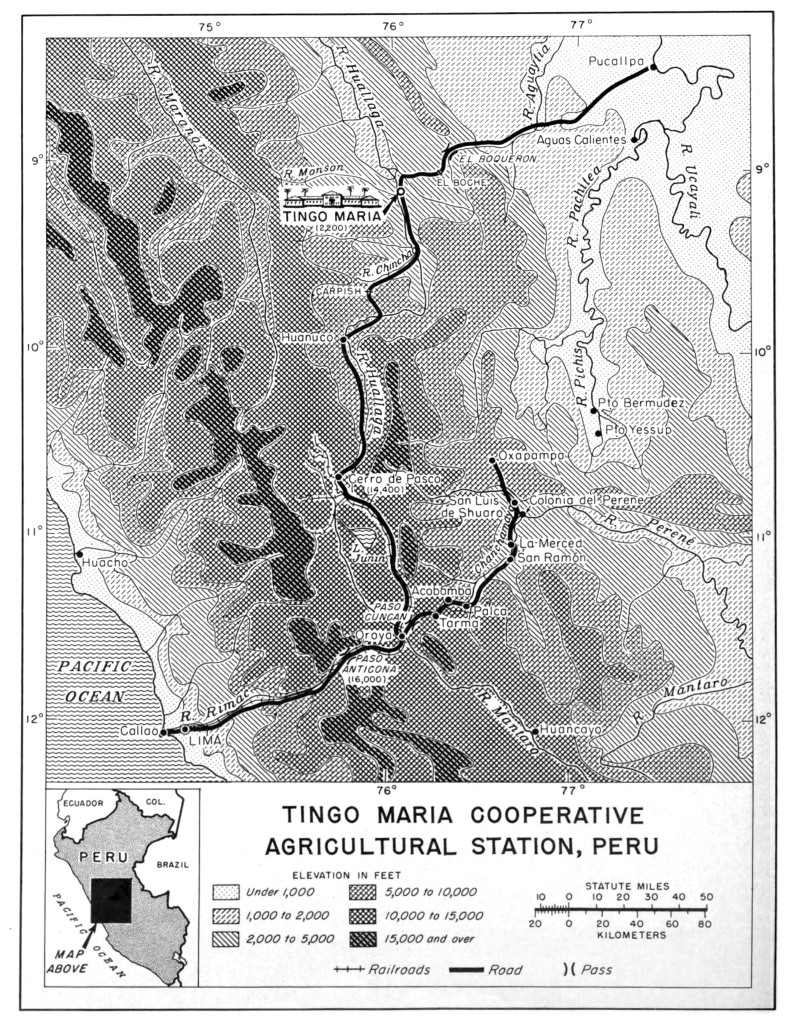
Till 1936, when highway building hollowed out the jungle to attach the Huallaga River valley area to the Pacific coast, Tingo Maria was nearly unreachable and uninhabited. seventeenth century Jesuit missionaries, after listening to from indigenous peoples about a big metropolis wealthy in gold referred to as Paititi, believed that the impenetrable jungles on the jap slope of the Andes hid the misplaced metropolis of El Dorado. That metropolis was by no means discovered—however in its stead, after the completion of a 424-kilometer freeway, Carretera Numero 2, between Huanuco and Pucallpa, the hamlet of Tingo Maria grew.
After Peru’s president, Manuel Prado, yielded to political and financial strain from the USA following the bombing of Pearl Harbor, he severed relations with Japan in 1941 and in 1942 imposed a program of land confiscation—expropriating land from Japanese in Peru and deporting them to internment camps within the U.S. This expanded the federal government’s energy to expropriate land for highway improvement—granted beneath the 1938 Regulation 8621—which permitted the state to expropriate uncultivated mountain lands working alongside each present and deliberate highways. One of many areas expropriated alongside the Tulumayo river was Christened by the Peruvian authorities as Peru’s “Official Colonization Zone” in an effort to entice landless peasants residing within the Andes to settle the world and put it to agricultural use. This agricultural colonization program introduced settlers to the Huánuco Area resulting in speedy progress round Tingo Maria and conversion of land into agricultural use.
In the meantime, embroiled in theaters of struggle throughout Europe, Asia and Africa, the U.S. authorities sought new sources for uncooked supplies vital for its struggle efforts, resulting in the institution of recent Tropical Analysis Stations the world over. On April 21, 1942, the USA Division of Agriculture entered right into a contract with Peru’s Division of Colonization and Forestry for help with a mission: The Tingo Maria Agricultural Station. The New York Instances in 1943 reported that “The US, by means of the Division of Agriculture, in cooperation with the State Division is contributing monetary and technical assist, whereas Peru is contributing land, buildings and different amenities.”
The Estacion Experimental Agricola was “certainly one of a collection of agricultural experiment stations being established all through the American tropics designed to help and encourage the manufacturing on a big scale of rubber, quinine and different merchandise previously obtained from the Far East.” Within the early years of the agricultural experiment station close to Tingo Maria, it was run by scientists from the U.S. Division of Agriculture—the primary, in 1943, was Dr. Benjamin J. Birdsall—in cooperation with the director of forest lands and colonization. In its first decade, a complete of 23 American scientists served on the station, usually with 5 on responsibility at a time and a purpose of “working themselves out of the job” by “coaching Peruvians to take their locations.”
Collectively, the Individuals and their Peruvian counterparts “labored on issues of crops within the Peruvian jungle lands mendacity east of the Andes and on the headwaters of the Amazon River. These are crops vital not solely to the Peruvian financial system but additionally to the USA market.” With U.S. backing and assist, the station grew to become “the hemisphere’s premier tropical extension station.” On the station, beneath experimentation have been “espresso, pasture or forage grasses, bananas, rubber, cacao, citrus, forestry merchandise, oil palms, tea, rice, corn and several other different merchandise. A dairy herd can be maintained, and work is being carried on with pigs, rabbits and poultry.”
In 1946, the Tingo María Colonization Zone was established; by 1960, over 40,000 acres have been planted with crops—mainly amongst them, espresso:
The settlers have typically established their espresso within the forests after cleansing solely the underbrush. This technique which can give passable ends in areas the place the higher story of bushes is constituted by species appropriate to shading is detrimental to the manufacturing the place these species by their form or improvement can’t be managed to kind the sort of cover suited to the crop. Such a system is of probably the most intensive kind, the espresso being grown virtually like a forest tree. In very steep land this technique of exploitation has nevertheless the benefit of being virtually ultimate from the viewpoint of soil conservation.
Within the Fifties, plantings of the crop expanded, reaching 5,000 hectares in 1962, in response to the report “Espresso Exercise in Tingo Maria” from the SIPA Socio-Agroeconomic Research Workplace.
The Experimental Station, which coated 225 hectares, performed a essential position in agricultural analysis because the trade round it and the variety of cooperatives it supported grew—cooperatives that included Pucate, Arequipa, Piura, Central de Cooperativas de Aucayacu, Agraria Naranjillo and El Porvenir. Stories from the early years present that the research carried out by the researchers on the station examined productiveness, illness resistance, investigations of crop enchancment, and, notably: selection trials. In these trials, cultivars from different locations have been planted in fields across the station to look at their traits and behaviors. A standing report printed in 1958 supplied a abstract of the stations plans to “undertake selection trials in six totally different localities, together with the Tingo Maria Experiment Station. Seeds of espresso varieties and additional info on this check have been despatched upon request.”
A few of the preliminary cultivars planted round Tingo Maria are recognizable by their modern-day names; others are much less generally used at present or much less well-known. Every kind could be planted each in shade and full solar each close to Tingo Maria in addition to surrounding areas of Tulumayo, Tingo Maria Tea Backyard, Convencion, Satipo, Chanchamayo, Tarapoto and Moyobamba with a trial length of 10 years In accordance with a 1957 report from the Inter-American Institute of Agricultural Sciences, the preliminary plan for selection enchancment trials included: Native, Columnaris, Mundo Novo, Caturra Rojo, Sumatra, Bourbon Salvadoreño, Bourbon Amarillo, Villalobos and Villasarchi.
Notably absent from this listing: Gesha, or some other apparently Ethiopian-type espresso.
However: one other 1957 report from the Worldwide Cooperation Administration later made out there by the Workplace of Public Data, “Technical Cooperation By means of American Universities,” famous that alongside the Tingo Maria station’s exploration of Ethiopian kinds of corn (which “did higher beneath improved strategies of cultivation”), and cross-breeding of Ethiopian cattle (which “has proven very nice potentialities”), “a lot consideration has been given to espresso cultivation—one well-known selection is native to Ethiopia and low is already an vital export.”
And, Quantity 14 of Financial Botany from 1958 notes that “Previously six or seven years Ethiopian coffees have been systematically launched within the Western Hemisphere.” The 14 varieties collected in 1951 by the Agricultural Explorer of the Part of Plant Introduction of the USDA have been forwarded to “a number of Stations south of the Rio Grand.”
An entry numbered 2730 within the CATIE repository recorded that in 1953—previous to the introduction of supplies from the FAO mission to Ethiopia—the institute acquired germplasm from Kenya that was designated “Choice L. 9” or “S.L. 9.”
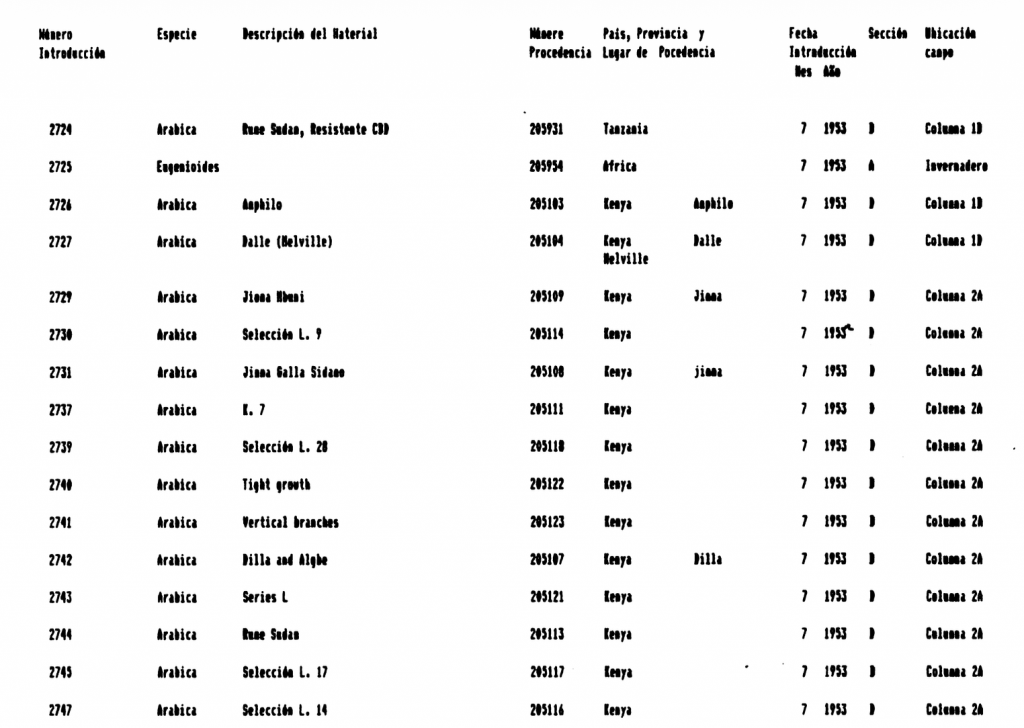
Based in 1903 by the Kenya Colonial Administration beneath British rule, Scott Agricultural Laboratories in Kenya performed a central position in rising the espresso sector in Kenya. As a part of its work, Scott Labs, like different tropical analysis stations, applied a range enchancment program—from which SL-9 emerged.
Whereas the origins of its better-known and widely-cultivated friends SL-28 and SL-34 are pretty effectively established—SL-28 being a 1935 choice from Tanganyika Drought Resistant bushes planted at Scott Laboratories (initially collected in Tanzania) and SL-34 coming from a single-tree choice from the Loresho Property planted by the founding father of the notorious Blissful Valley set ostensibly from “French Mission Bourbon” seeds—SL-9 was, in response to a bit written by P.A. Jones, the Agricultural Officer of the Espresso Analysis Station, in a 1956 bulletin from the Espresso Board of Kenya, “from a block of unknown origin.”
Like India, which created the different cultivar typically known as SL-09 (although higher and extra precisely referred to as “Choice 9”), Kenya held collections of germplasm from Ethiopia—from a 1929 introduction by means of the British Consul in Harar; from a 1936 choice collected by the British Consulate within the Gesha and Amfillo districts some claimed to have been proof against espresso berry illness; and from a group of specimens named “Dalle, Dalle-Combined, Dilla, Dilla and Alghe, Gimma Mbuni, and Gimma Galla Sidamo” gathered by three coffee-curious military officers throughout an Ethiopian marketing campaign in 1941-1942 (the Scott Labs choices later referred to as SLs, although, occurred between 1935 and 1939, which excludes germplasm from the later marketing campaign).
Along with Ethiopian varieties, Scott Labs additionally held materials from different sources which might show integral to the Scott Labs selection trials: French Mission, a heterogenous kind coming from three totally different introductions starting 1893 from Yemen, Bourbon and a kind much like these grown in Central America; Mokka, launched in 1934 from Puerto Rico however initially from Java; Kents, an F5 launched in 1930 descended from a range by L. P. Kent in 1911 of a single tree rising on his Doddengoodda Property in Mysore; Mysore, a heterogenous kind proof against Espresso Berry Illness imported in 1908 from Southern India; Blue Mountain, launched in 1913 from the Blue Mountains of Jamaica, the place it had been established in 1730 from progeny in Martinique from a single plant on the Botanic Backyard in Amsterdam taken in 1723; Guatemala, whose options have been much like Blue Mountain; San Ramon, a dwarf from Central America; Padang, launched from Puerto Rico, “whence it had been launched from the Botanic Gardens, Buitenzorg, Java, in 1908”; Columnaris, which was launched from Puerto Rico round 1931 however initially got here from the Pantjoer property in Java; and Maragogipe from Bahia, Brazil. Different varieties later added included Rumé Sudan and Barbuk Sudan.
Scott Labs contained blocks grown from its germplasm assortment to discover particular traits of every of the choices corresponding to drought resistance. Drought Resistant I (D.R. 1) and Drought Resistant II (D.R. II) blocks have been established in 1933 in Kabete from unknown origins of its assortment (however doubtless derived from the French Mission choices); each had broad leaves and bronze ideas (D.R. I being gentle bronze, D.R. II being darkish bronze); Tanganyika Drought Resistant was chosen from a bronze-tipped considerably disease-resistant selection in 1931 from Rasha Rasha in Tanzania that appeared much like Bourbon however produced decrease yields however a excessive proportion of elephant beans of outstanding high quality.
From these blocks, all the “SL” designated cultivars originated, derived as single-tree choices—together with SL-09. In accordance with the 1956 bulletin:
…some 42 bushes of varied origins have been chosen and studied for yield, high quality, and common options, corresponding to drought and illness resistance. Many have been discarded after a yr or two, others survived and have been subsequently discarded. The fifteen that are described right here have been continued lengthy sufficient to be included in selection trials and a few of these have proved sufficiently precious to benefit their distribution for industrial use.
Due to its lack of resistance to rust and its susceptibility to espresso berry illness, the range was by no means distributed. In different phrases: so far as any historic proof reveals, SL-09 was by no means—not like SL-34 and SL-28—commercially grown exterior of Kenya (I did discover proof of a selection trial in Malawi the place SL-09 was planted alongside its more-famous friends).
Subsequently, even when it genetically appears to be intently associated to SL-09, Inca Gesha can’t be SL-09, except: maybe—by some coincidence—the tree that will be chosen to create SL-09 was the identical kind of tree that appeared in Peru many years later.
In 1964, 5 scientists representing the Meals and Agriculture Group of the United Nations joined 5 observers from Ethiopia on a mission to Ethiopia “to assemble botanical, entomological, genetical, and horticultural information for the rise of information and understanding of the Arabica espresso plant.” The mission’s crew included L.M. Fernie, a plant breeder representing Tanzania, Kenya and Uganda; D.J. Greathead, an entomologist representing Uganda; L.C. Monaco, a geneticist from Brazil; R.L. Narasimhaswamy, a breeder from India; and the mission’s chief, Frederick G. Meyer, a botanist representing the USA.
Between October 15, 1964 and January 15, 1965, the crew traveled by means of Ethiopia’s major rising areas from North-to-South, gathering information concerning the varieties being grown together with productiveness, top and branching tendency and illnesses current. They collected information associated to obvious susceptibility of espresso leaf rust, different pathogens, and pests in response to every of their specialties, documenting their findings in a report offered in Rome in 1968.
The scientists collected a trove of germplasm: 621 complete collections of seeds of Espresso arabica, which, following the mission, have been despatched to the Plant Introduction Station in Glenn Dale, Maryland for seedling manufacturing and distribution. Germination charges have been above 90% in some collections and, from 488 introductions, resulted in 11,000 seedlings. On June 1, 1965, these seedlings have been distributed to analysis stations the world over.
488 seedlings have been despatched to the Instituto Interamericano de Ciencias Agropecuarias (IICA) in Costa Rica. Just like the station at Tingo Maria, IICA—recognized at present as CATIE—which, just like the station at Tingo Maria, was based in 1942 throughout the USA’ wartime prioritization of analysis and the State Division’s efforts to affect Latin American politics. Starting in 1948, the station started constructing an ex-situ assortment of espresso germplasm to function a reference for analysis. This assortment later would kind the first gene financial institution later used for genetic fingerprinting by RD2, CIRAD, WCR and different researchers.
In accordance with the FAO mission report, seedlings have been additionally despatched from Glenn Dale to Peru: “on the Analysis Station, Tingo Maria.”(a listing of accessions despatched to Peru, which pattern all areas surveyed, is listed starting on Web page 153 of the report). Of the 455 seedlings despatched to Peru, the Experimental Station at Tingo Maria reported {that a} yr later, in June 1966, roughly 434 had survived.
This introduction of germplasm from Ethiopia would turn out to be a part of the crop enchancment packages at Tingo Maria. However, after the FAO crew’s 1968 report, no additional or extra modern report of these plantings—or some other data of any type from the analysis station at Tingo Maria—exists.
By 1974, native newspapers “buzzed with tales of a brash new class of native ‘Narcos,’” primarily based round Tingo Maria.
The U.S. management of the Tingo Maria agricultural analysis station ended abruptly in 1968 on the imposition of Common Juan Velasco’s agrarian land reforms. The reforms dismantled the hacienda system, aiming to interrupt up massive estates and redistribute land to state-established agricultural cooperatives and promote the agricultural use of land by peasants. By then, the Worldwide Espresso Settlement had been in impact for six years, with an up to date settlement ratified the identical yr because the land reforms designed to stabilize world espresso pricing by establishing export limits for member nations. Peru’s export quota in 1968, 740,000 luggage, was simply above 1/10 of Colombia’s quota; by the tip of the Seventies, over 80% of this quantity got here from cooperatives, farmed by indigenous folks and campesinos. However the state left the cooperatives underfunded and failed to supply companies exterior of that bureaucratic construction, leaving campesinos with little market entry, no authorized protections, restricted education and well being companies, and no political illustration beneath a navy regime that suspended elections when it rose to energy.
On this political vacuum, tensions rose—with leftist opposition to the federal government rising and regional authorities rising to fill the absence of companies from the central state.
Amidst this pressure, the Marxist-Lenininist-Maoist impressed Sendero Luminoso motion emerged. Based in Lima in 1969 by Abimael Guzmán, a philosophy professor at San Cristóbal of Huamanga College, and a gaggle of his college students, the group unfold their motion by embedding itself in rural communities in Ayacucho, reframing their Maoist philosophies to reply to the marginalization of those communities by Lima. They encoded their ideology in native histories of racial exclusion and rural neglect, utilizing a marketing campaign of training and literacy to ingrain themselves within the countryside and filling a void left by the state.
When, in 1980, the navy authorities of Peru allowed elections for the primary time since 1968, Sendero Luminoso declined to take part, as a substitute burning poll bins on Might 17 in Chuschi, marking the beginning of their “folks’s struggle.” Because the motion gained energy within the Andean highlands and violence escalated, the federal authorities intervened, responding with reprisals, indiscriminate repression, massacres and disappearances—supporting the SL’s narrative that the federal government in Lima was corrupt, racist and disinterested within the lives of the indigenous and rural peasants, aligning their pursuits additional.
In the meantime, because the urge for food of cocaine among the many American public grew, so too did cultivation of coca within the Andean jungles of Peru and the Higher Huallaga Valley round Tingo Maria. Whereas coca has an extended historical past of use by indigenous peoples—chewed or ready as a tea for its delicate stimulating results, mentioned to alleviate the signs of elevation illness—one of these intensive manufacturing provided the chance for farmers to earn extra money than espresso, which by 1980 coated some 153,000 hectares of Peru—47,404 hectares of which was across the Higher Huallaga Valley.
Whereas espresso had soared to a report excessive worth of $3.40 per pound in 1977 within the wake of the 1975 “Black Frost” in Brazil, when manufacturing and demand returned to regular in 1978, the market fell sharply to a three-year low of $1.06 per pound.
Coca provided distinct benefits over espresso: steady farmgate pricing, quick money fee, as many as 6 harvests per yr, little labor necessities, few infrastructure wants and little danger of single-event failure occasions like frost. And so the world round Tingo Maria—as soon as recognized for espresso—grew to become a middle for coca manufacturing in Peru as 1000’s of peasants poured into the world within the Seventies to develop the alkaloid-laden shrub.
By the early Eighties, the USA, engaged within the Reagan administration’s Struggle on Medicine, launched into a method of crop substitute and eradication within the Higher Huallaga Valley and different elements of Peru, offering funding and help to the Peruvian authorities in efforts to destroy coca plantings the place they discovered them whereas making an attempt to incentivize alternate crops like espresso, cacao, tobacco, bananas and corn.
For the Shining Path, this provided a possibility for the motion to ingratiate itself with the native inhabitants by serving as safety from the federal government and police towards destruction of the dear crop. Funding their operations by taxing traffickers and refiners, the rebels positioned themselves as armed regulators of the narco commerce across the area. Consequently, “between 1984 and 1990, [Government of Peru] officers responded to heightened insecurity by abandoning the area to narco-traffickers and the Sendero Luminoso.”
On account of the risk posed by narcotraffickers and the SL, by 1984, the USA suspended its direct participation in this system of coca eradication, expatriating Individuals engaged on the efforts in Peru whereas persevering with funding for his or her companions within the Peruvian authorities. The Shining Path’s actions—which suited the American administration’s narrative—made information in the USA. A piece in The New York Instances from November 1984 described an assault by the SL on the U.S. financed Coca Discount Group by 50 males with submachine weapons:
All these killed within the assault, which befell early Saturday, have been recognized as Peruvian staff of the Coca Discount Group. The group is collaborating in a $30 million program that the United States is financing to chop the manufacturing of coca alongside the Huallaga River, the place many of the unlawful coca in Peru is grown.
A 1987 article within the LA Instances reported:
Shining Path rebels burned Tocache’s metropolis corridor to the bottom in April and ordered the mayor, the prefect and different officers out of city. The guerrillas named “delegates” to gather taxes and preserve important public companies corresponding to electrical energy and water, in response to townspeople.
“There nonetheless are not any civilian authorities right here,” mentioned Vidal. “They refuse to return to their posts as a result of they concern we are going to go away and the terrorists will come again and kill them for collaborating.”
The guerrillas have found they will simply win assist by presenting themselves because the defenders of coca farmers, who’re indignant on the U.S.-financed coca eradication program. The Shining Path has ambushed and killed employees within the eradication effort as a part of its marketing campaign of terror.
A report from the American Embassy in Lima summarized the violence, noting that “In 1986, the scenario worsened when SL began selective assassinations of the mayors of Tingo Maria, Pumahuasi, Augayacu, and Pueblo Nuevo” in addition to “destruction of valley infrastructure.” Because the affect and management of the federal government collapsed, the Sendero Luminoso expanded their marketing campaign of extortion—focusing on cooperatives within the Huallaga River Valley and the analysis station in Tingo Maria. In accordance with a USAID report titled “Selva Financial Revitalization Challenge”:
Nearly no assist for utilized or fundamental analysis has existed since 1987. This lack of funds for utilized or fundamental analysis was the results of destruction of the experiment station at Tulumayo. In September 1984, an assault on the experiment station was staged by SL. This assault destroyed the meteorological station, places of work and laboratories of Servicio Nacional de Meteorología e Hidrología (SENAMHI), in addition to two electrical turbines.
Then: “In January 1986, the SL attacked the agricultural experimentation station at Tulumayo and destroyed the labs, the library, discipline tools and automobiles. In 1987, the SL once more attacked the station and destroyed data of on-going discipline investigations.
In August 1988, the SL attacked once more, for a 3rd time—dynamiting every thing that remained. As reported by the American embassy: “There was one other assault on the Tulumayo agricultural experimental station that fully destroyed it. With it have been misplaced the data of over 50 years of experiments on crops adaptable to the [Upper Huallaga Valley] surroundings.”
The entire data stored there—of discipline trials previous and current, of germplasm and varieties collected from world wide together with in the course of the FAO mission in 1964, of distributions of seeds and seedlings—have been misplaced.
I knew from the RD2 report that there needed to be some widespread lineage between the range referred to as SL-09 and the one we referred to as Inca Gesha. I knew that it wasn’t Gesha, although I’d been in a position to set up that, at the very least sooner or later in and probably earlier than 1966, Gesha varieties had been distributed to Peru and grown close to Tingo Maria and knew that, within the mid-2010s, Gesha seeds had been sprouted and distributed amongst buddies.
Espresso bushes produce recalcitrant seeds; that’s to say, the seeds can’t germinate after being dried and frozen, and so with the intention to protect genetic materials for examine or breeding, it should be grown and stored alive within the discipline. Any such assortment—the one at Scott Labs, and at CATIE, and elsewhere on the earth—is named an in vitro assortment.
Preserving this materials can pose challenges—it requires that bushes be stored alive, free from pests or illness. A 2019 stock of the gathering at CATIE revealed that 80 complete accessions had been misplaced, fifty-six of which have been C. arabica, making these varieties inaccessible both for genetic examine or future breeding work. Of the 80 misplaced accessions, two have been from the FAO mission—whereas one other 50% of the 202 ‘threatened’ accessions have been from the 1964 mission.
It may be troublesome to make sure the genetic stability of strains, notably when new generations are grown from the seeds produced by the gathering. Whereas some research assist the widely-believed notion that Arabica self-pollinates 85-90% of the time and that the “most well-liked autogamic reproductive trend of the species permits solely a ten% of cross fertilization”, “current works in Ethiopian forests present that this share may go as much as greater than 50%,” and additional, “a number of research corroborate that espresso pollen will be transported by wind or bugs over a distance of as much as 2 km.” Even when low in likelihood, although they have been planted in distinct, separate blocks, the varieties at Scott Labs may probably have cross-pollinated, with the ensuing fruits getting used for subsequent discipline trials. And with the heterogenous nature of the blocks referred to as “French Mission”, this appears much more doubtless nonetheless.
And, in fact: genetic mutations happen naturally and randomly in all life.
By means of these phenomena—mutation, adaptation, choice and hybridization—occurring collectively or aside can, over time, lead to genetic drift in a inhabitants—even when the beginning materials was genetically equivalent (Because of this, some producers of highly-prized Panamanian Gesha observe cloning of their award-winning bushes fairly than propagating new generations from seed in order to make sure precise gene copies between them). That’s, as a result of they’re alive and interacting with one another and the surroundings, within the context of discipline trials or on small-scale farms operated by campesinos, a level of genetic drift can happen even amongst bushes of verified genetic origin—creating evolutionary forks that ultimately could lead to altogether new varieties.
Genetic research can decide the diploma to which these shifts could have occurred. The one germplasm assortment present in Peru at present lives in vitro on the La Génova property of the Nationwide Agrarian College La Molina in Junín began in 2011, containing some 211 accessions collected from 11 coffee-growing areas of Peru plus 19 cultivars launched from Brazil. A 2014-2015 catalog of the taxonomy was produced evaluating the morphological and agronomic traits of the accessions utilizing 16 qualitative and 28 quantitative descriptors. The examine confirmed that the totally different accessions confirmed better variability for the quantitative traits, and for the qualitative traits a sure polymorphism was noticed.
A later 2021 examine within the Chilean Journal of Agricultural Analysis examined the genetic range of the gathering utilizing microsatellite markers and Sequence-Associated Amplified Polymorphism technique of research. Slightly than producing a forensic identification of a person tree, one of these genetic assay is ready to make a willpower of how associated a inhabitants is. In different phrases, it’s in a position to distinguish between closely-related Arabicas by clustering related varieties. Slightly than being able to reply particularly the query, “Is that this unknown tree Gesha?” it may possibly decide if it exists in the identical cluster of bushes which can be associated to Gesha. That is helpful, nevertheless; if we’re in a position to detect overlaps and relations within the broader inhabitants, it may possibly present insights into the historicity of sure cultivars current.
The examine concluded that “The excessive genetic differentiation and genetic structuring of the accessions would point out that the cultivars, from which the accessions have been originated, have been preserved over time,” and additional, that “The genetic range of Peruvian espresso is perhaps the consequence of an extended historical past of introductions of cultivars from totally different origins.” The authors cost that “these accessions may not be very totally different from the cultivars from which they have been generated, after being launched to Peru” and famous a comparatively excessive stage of genetic range amongst Peruvian cultivars.
And, notably, the authors observe that it’s attainable “that in some areas of Peru there are nonetheless descendants from a gaggle of genotypes arrived in Peru from Ethiopia and Eritrea due to a FAO expedition of 1964-1965.”
I scoured the stock of types grown at Scott Labs and cross-referenced them to these I’d been in a position to set up have been—or had as soon as been—grown in Peru.
If SL-09 was a single-tree number of unknown origin from Scott Labs plantings, it had to derive from the gathering there. I’d hoped to, by some means, determine which assortment.
It was conceivable that, like SL-34, which was a single-tree choice from the heterogenous French Mission Bourbon group that contained materials from Yemen, SL-09, one other single-tree choice, may have originated with that group. However whereas they share some attributes (each having broad leaves, for instance, and each extremely prone to Espresso Berry Illness), there are variations: SL-09 new leaves are copper, whereas SL-34 are inexperienced. They’re genetically and morphologically totally different—even when associated in the identical descended-from-Ethiopia occasion cluster.
However as I seemed nearer, I used to be struck by an oddity. Amongst these varieties that I anticipated to see—due to the FAO mission, due to the widespread supply of fabric grown in Peru historically—I noticed a cultivar that I’d by no means heard of earlier than, which was included on the unique listing of selection trials meant for Tingo Maria documented within the Fifties and was launched to Scott Labs in 1931.
First found in Java within the late Eighteen Eighties on the the Pantjoer property in Java, across the similar time as the primary introductions from Yemen to Kenya—Columnaris was established commercially in Puerto Rico due to its “glorious” cup high quality and “quantity of yield.” Initially chosen by the Dutch espresso planter Ottoländer, no data exist of its origins as he died with out leaving data—however primarily based on the historic motion of espresso to Southeast Asia, it’s logical to imagine that it shares a pathway to Indonesia from Ethiopian “Abyssinian” varieties through Yemen.
That might match the “Ethiopian Legacy” pathway uncovered by the RD2 report. What if SL-09—and, Inca Gesha, coincidentally, by extension—was really Columnaris?
Columnaris first produced cherry in Puerto Rico on the experimental station in 1912, “a yr later than the common Arabian espresso started to bear”—a bent for later bearing which was apparently confirmed in subsequent plantings in 1915 which got here to bear in 1919. The of Columnaris yields have been famous to be “passable and decidedly so within the decrease, extra fertile part of the planting.” The tree was famous in a 1914 Report of the Assistant Horticulturist on the Puerto Rico Federal experiment station to be “extra vigorous and grows taller than the standard Porto Rican espresso” and with a bean measurement that was “a trifle smaller” than Puerto Rican native cultivars.
World Espresso Survey, printed by FAO, noticed that Columnaris (referred to there as columnaris Ottoländer ex Cramer, named for its breeder and Cramer, who described it) was grown in Peru by the point of the report’s publication in 1959 although in very small quantities, per selection trials: “The typica number of C. arabica is virtually the one one grown in Peru; very small quantities of bourbon, maragogipe and columnaris being cultivated.”
The primary selection trials performed by Scott Labs, as reported in a 1940 Espresso Board of Kenya Bulletin, included Columnaris. In that first trial, the Columnaris bushes “present no debilitation, due mainly to the truth that it’s a ‘shy bearer’.” A 1956 Espresso Board of Kenya Bulletin famous that Columnaris “produces very lengthy and whippy laterals, profuse secondary progress, slim mature leaves and copper terminal leaves. The shy bearing tendency, particularly at larger altitudes, has been confirmed by trials in Kenya.” In the meantime, SL-09 was noticed to “yield heavy crops of fine high quality on the center altitudes.”
Along with sharing copper terminal leaves like SL-09, Columnaris was noticed by Scott Labs to be very prone to Espresso Berry Illness, a trait which made SL-09 unsuitable for distribution. Additional, whereas each SL-09 and Columnaris have been theoretically prone to the identical strains of Hemileia vastatrix (I, II, VII, XV), they have been reported in Kenya solely to indicate an infection with race II—a circumstantial commonality shared between solely 9 of 38 varieties studied at Scott Labs together with SL-18, which was, like SL-09, described as broad-leafed and copper-tipped however not like SL-09 is understood to have come from a range from D.R. I in 1936 (itself a block of unknown origins however doubtless the Yemen-originated French Mission selection).
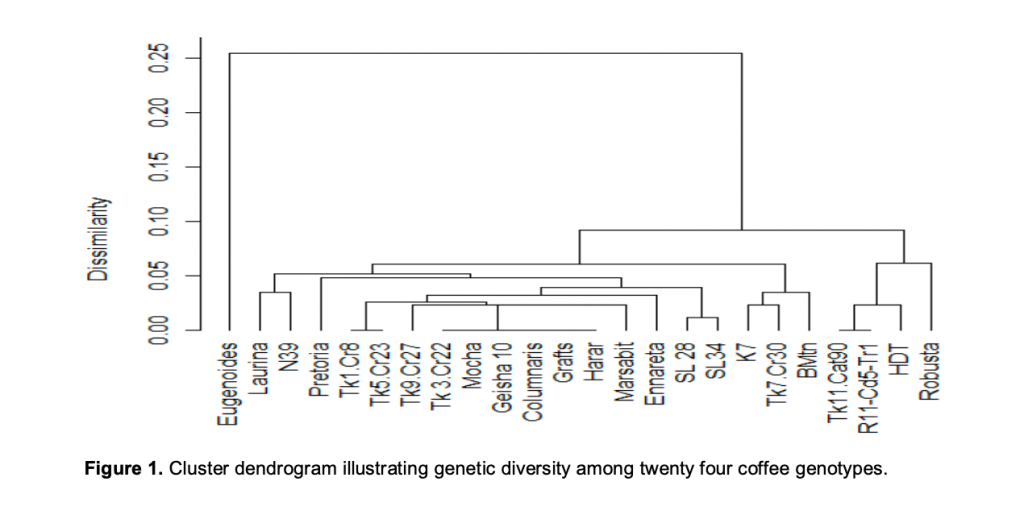
In a paper printed in 2011 within the Worldwide Journal of Biodiversity and Conservation, researchers used molecular markers to investigate the genetic range of Kenyan industrial espresso and Kenyan museum collections. The RAPD + restricted SSR technique utilized by the researchers is now largely thought of out of date; it doesn’t provide high-confidence discrimination between closely-related Arabica varieties, distinguish between totally different Ethiopian landraces at excessive decision, nor present forensic-grade identifications just like the strategies utilized by RD2. However: it does provide the flexibility to determine introgressed supplies, present slim range amongst C. arabica and cluster varieties by associated genotypes. Amongst these genotypes examined included SL-34, SL-28 and K7 and Geisha 11 from Kenya—and Columnaris from Puerto Rico. In accordance with the authors,
Shut genetic proximity was noticed among the many present conventional industrial varieties in Kenya, specifically SL28, SL34 and K7. These outcomes are in settlement with the work of Agwanda et al. (1997) and Hue (2005) which revealed excessive genetic similarity between Kenyan conventional industrial varieties.
Showing collectively in a cluster of associated varieties have been Ethiopian landraces and varieties that will be anticipated—Mocha, Geisha 10, and Harrar—in addition to Columnaris:
The 1994 catalog of the CATIE germplasm financial institution reveals three introductions of Columnaris to the database, 2144 (IAN-95), 2397 and 3411, coming from Guatemala in 1952; Puerto Rico in 1953; and Boquete, Panama in 1956, respectively, greater than 20 years after its introduction to Kenya however indicating that the range was grown extensively throughout the Western Hemisphere, becoming earlier descriptions of distribution of non-Bourbon and non-Typica cultivars. Notably, the CATIE assortment does not embody materials from the unique Columnaris assortment in Kenya—and thus, we lack a real genetic reference for it.
It’s completely attainable that there isn’t any relation; the latency between its authentic discovery and later distribution could create points with the genetic integrity of the range, notably since “Columnaris” seems to have been used as a morphological selection title fairly than a verified genetic lineage. In different phrases—it’s doubtless heterogenous, and kinds referred to as “Columnaris” might not be consultant of others. And, in fact, as famous by Dr. Montagnon and his collaborators a couple of totally different SL selection, SL-06, in a 2021 paper: it’s not attainable to low cost the potential of “potential mislabeling or mixing wherever between the Kenyan analysis stations and the CATIE germplasm assortment.”
As cultivation of Arabica elevated and unfold in Peru, plantings have been dominated by Typica; a crop substitute scheme funded by the U.S. by means of USAID elevated the quantity of cultivation of Caturra and Bourbon, notably within the South of Peru, however modern adoption of Gesha seeds of verified origins from Panama has been motivated by a want for larger premiums paid by specialty consumers.
Adoption of recent varieties tends to be a neighborhood phenomenon; farmers discover fascinating traits in a tree or block of their farm and choose these bushes for breeding or cloning, rising the variety of plantings within the hopes of expressing these traits in a productive inhabitants.
This observe of adaptive genetic administration can enhance the resiliency and profitability of a farm—in addition to result in the speedy proliferation of genetic materials of in any other case unknown origins. Gesha, for instance, gained reputation initially not due to its cup high quality however due to its resistance to roya; so too did Pink Bourbon. Chiroso, as soon as believed to be a mutation of Caturra or Bourbon, was adopted due to its excessive yields, rust resistance and ease of harvesting. As soon as a cultivar is established domestically, it tends to, with out a single-event failure, proceed; in the meantime, its true origins can shortly turn out to be misplaced to time, at the same time as its variety of plantings develop.
It’s completely believable that Columnaris—or another Ethiopian-type espresso stemming from the FAO missions or earlier—discovered its method throughout the Andean highlands as peasants migrated away from Tingo Maria and the Higher Huallaga Valley for safer pastures, propagating new bushes from seed they’d collected and transported.
However, no matter it’s, the tree referred to as “Inca Gesha” is cultivated extensively throughout Peru and is famend by consumers for its high quality and Ethiopian-like cup profile. Even when it comes from the identical genetic inventory as SL-09 and thus could possibly be thought to be the identical, Inca Gesha isn’t SL-09 and it may possibly’t be—it got here from different sources, unbiased of the work carried out by Scott Labs in Kenya a century in the past, which remained Kenya-bound. It doesn’t come from Kenya—so why would it not be named as such?
Inca Gesha, any obvious introgression or heterogeneity however, would possibly as effectively be thought to be a definite selection in its personal proper, tailored to its native surroundings and connected to a neighborhood mythology, historical past and sense of place.
And maybe—with its origins misplaced to time—as a substitute of naming it after a genetic reference by no means distributed, we must always name this cultivar by the title given to it by the individuals who develop it.
Tags: espresso cultivars ethiopia gesha inexperienced espresso historical past inca gesha kenya origins peru varities


