
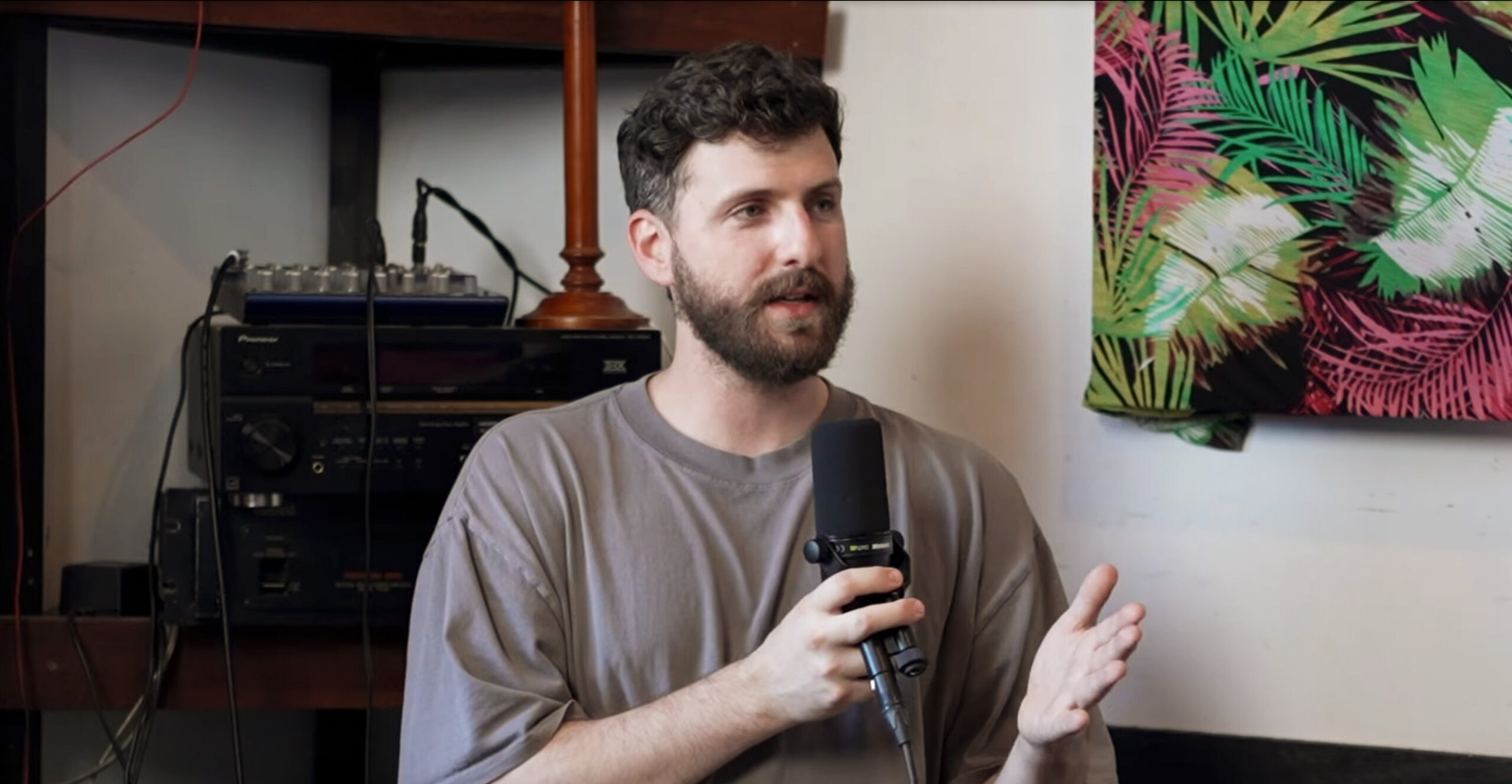
“We ought to be hyping this extra” was a quote from a podcast we recorded this week. We’d simply completed a blind cupping; one which could possibly be extra pivotal than we would prefer to admit. You’ll by no means guess what we had been tasting …
Earlier than I inform you, right here’s some background to assist put together you for the shock. You’ve heard of The Espresso Present with Kirk Pearson, proper? Kirk’s a coffee-journalist of such enterprise that he not too long ago grabbed an interview with the brand new WBC champion Jack Simpson, inside thirty minutes of him stepping off the rostrum. He’s additionally the beating coronary heart of the co-fermention motion/craze (Which is it!?). He’s the brains behind Sub Zero; the ‘extremely specialty’ frozen menu pop-up store. AND, his cafe in Melbourne’s CBD referred to as Challenge Zero does upwards of 500 coffees a day utilizing one three-group machine. All this stated, essentially the most noteworthy credential for Kirk Pearson is on the subject of velocity of service, he travels at Warp 3. There isn’t any one who makes a latte to-go sooner than Captain Kirk.
He makes a latte sooner than an Eversys machine; he makes turbo shots look like stop motion animation. “How”, you ask? Well, he does it by pre-making the espresso. That’s right, he’s batching all the shots he needs before the customers arrive. And not just in the morning — up to 96 hours earlier!! To us that’s wild. It’s breaking one of coffee’s biggest taboos. One that goes back to the very beginnings of espresso culture, where the best coffee was made ‘expres pour vous’.1 As in, ‘made especially for you’.
 Moriondo’s lost espresso machine — there are no known Moriondo machines still in existence but in this advertisement, you can see Moriondo’s pre-made coffee bottles in the centre-right of the photo


A Reiss ‘Vienna’ Coffee Pot (left), Photo by Ian Bersten; a Cuccumella from Naples(right)
How sacrosanct is espresso lore really? Single serve is not actually a first principle of espresso culture. Take Moriondo’s ‘machine’ from 1884 as an example. It was a batch brewer*. It could make thirty coffees in one go. Moriondo’s brew basket was designed to fit around 600 grams of coffee. He actually sold wine bottles of pre-made coffee to take home. Also consider, the first written usage of the word ‘espresso’ that we’re aware of was made well before Moriondo. It came from a journalist named George Augustus Sala in 1869.2 As Sala explains, in Florence, in the 1860s, the term caffè expresso meant a strong coffee with four lumps of sugar. Sala never explained exactly how they prepared his “caffe espresso” but there’s a good chance it was made on a ‘Vienna’ coffee machine — one of the most popular coffee makers of the 19th century which was a reimagining of Parker’s Steam Fountain — an oversized precursor to the mocha pot which had a little reservoir to tap out the coffee when required.3 Or possibly in a Cuccumella (a percolation brewer where you boil the water and then flip the device upside down once the water is hot to allow the water to drip through the coffee. Both these devices were generally multicup brewers. So if you look at it like that, premaking and/or batching beverages called ‘caffe espresso’ could have a 160 year old precedent. So why are we getting re enthused about it now? Well, to the best of our knowledge, it’s never been done with hot coffee in the specialty era, and much more shocking than that, we actually really like the taste of it. More about that in a second.
Kirk doesn’t use any special storage receptacle; there’s no argon gas or thermal shock tactics. Kirk just pulls a bunch of shots and stores them in opaque sauce bottles in the fridge for up to four days. Kirk reckons since opening Project Zero, none of his customers have ever complained or even remarked on the premaking thing. It was when we heard that we decided to put a tasting panel together to find out how big of a difference there really is between lattes made with premade vs fresh espresso.
We had been a panel of 5 tasters and every taster was introduced with 14 separate lattes. On the panel we had not too long ago married tremendous baristas, Bronte Foster and Lloyd Meadows. The aforementioned Kirk Peasson. BH Founder and CEO, Matt Perger and our Dean of Research, Jem Challender. Between us we got here up with 66 information factors underneath blind
tasting protocols. Throughout 4 separate rounds, every panelist was requested to guess and state in the event that they thought a pattern was recent or pre-made. As a panel, we appropriately recognized 77% of the cups. At that success fee, we may inform the distinction between the style with robust statistical significance. So, there’s a little bit of a distinction in flavour, however let me inform you, it’s a really slight distinction. The attention-grabbing half is that the group really said a small however statistically important desire for lattes made with premade espresso. Does that shock you?
Please word, these had been milk Coffees we had been tasting, not espressos or lengthy blacks. So one factor this consequence actually speaks to is the highly effective results of steamed cows milk in augmenting the flavour of espresso. Additionally, it’s necessary to notice, the espresso was ready by Lloyd Meadows, so after all, the feel was extraordinarily easy, the bubble diameter was microscopic. The milk was non homogenised natural cow’s milk by Schultz dairy. With a 4% fats content material it is among the greatest milks for foaming you’ll discover anyplace on the planet. So many of the ensuing drinks had been stuffed with white Chocolate, digestive biscuit, and acacia honey sort flavours. If we had been cupping premade espresso vs reheated espresso, the outcomes wouldn’t have been shut. Reheated espresso is gross.
Outcomes
The group demonstrated a powerful collective potential to tell apart between the 2 espresso varieties throughout blind analysis. Total accuracy was roughly 77% throughout 66 scorable trials. We appeared on the statistical significance of the outcomes with an actual two-sided binomial take a look at in opposition to likelihood discrimination (p = 0.5) which got here out at p ≈ 0.00001, indicating that the probability of this degree of efficiency arising from random guessing is extraordinarily small. As a gaggle, the panel clearly perceived dependable sensory variations between the Contemporary and Premade coffees. So for positive, there’s a distinction in style. However you’ll be shocked by the subsequent half.
The place we had been rating out style preferences, the premade coffees acquired barely extra beneficial common rankings and extra first-place placements than Contemporary samples. Though this development didn’t meet typical thresholds for statistical significance (p ≈ 0.12), the path of the impact was constant throughout the dataset, suggesting a light group-level desire — albeit not a powerful one.
Let’s check out Matt Perger’s expertise as a part of the tasting panel for a second. Matt was the one one among us who was in a position to appropriately establish all fourteen consecutive cups he sampled. However, for nearly all of these, he rated the pre-made as his favorite. We mentioned this within the podcast afterwards. Matt defined that the premade cups had been rather less intense however smoother, and what they didn’t have was that barely acrid crema style. Jem Challender stated the identical factor — that crema or the absence of it was one of many essential markers for him in figuring out the cups.
A Scientific Rationalization
We consulted a flavour scientist on a few of these outcomes to get a greater understanding of what may be occurring right here. Right here’s what Dr Anja Rahn needed to say in regards to the crema facet of issues:
“My speculation can be that the acrid style is because of insoluble bigger molecules in the foam that land on your palate more readily . . . however this doesn’t explain why if you create a foam with espresso, induce a foam in the coffee through whipping or so I don’t believe it reproduces this acrid/bitter-ish taste. These larger molecules generally shouldn’t leave, so I would hypothesize it is the mode they are being delivered to your palate that makes them more perceptible. In foams they are almost out of solution, so not suspended or diluted, so more perceptible. But one should be able to reproduce it.”
We also chatted to world expert on foam chemistry, Prof Steven Abbott: Here’s what he pointed out:
“In both cases [fresh and pre-made es you have “foam fractionation”. As bubbles rise, hydrophobic molecules seize the chance to escape from the water by accumulating at the air interface, i.e. at the bubble surface. In champagne, the bubbles pop at the surface, releasing all those wonderful champagne aroma molecules into your nose … For PFAS, it’s the same thing, they are attracted to the bubble boundary, rise to the top and if you skim off the foam, you have concentrated PFAS which you dispose of in a suitable manner. So I suspect that the crema is attracting some of the nasty hydrophobic bitter compounds. I also suspect, without evidence, that these molecules, being relatively large and ponderous, stabilise the foam, meaning the crema lasts longer than it should. After all it’s a CO2 foam and CO2 foams last far shorter than the N2 foams of Guiness.”
So thanks to Anja and Steven, we have a very nice follow up experiment to try here: Where we cup two types of premade, one with artificially made crema — via a Nanofoamer — and one that’s just stock standard.
Time for a New Product?
If this experiment proves nothing else, I’d say it creates a fantastic mandate for cafes to start selling their own pre-made espresso for customers to take home and turn into lattes. You’d be drinking coffee made to the exacting standards of a skilled barista, brewed on their equipment which in many Aussie cafes set you back around A$25–30K, and all you’d need to invest is a stand alone milk steamer — like the nanofoamer Pro (which is surprisingly awesome) or maybe a little stovetop steam boiler. You already see espresso and cold brew concentrates in supermarkets in Australia, but it’s very underdeveloped territory for the specialty sector.
The Flair Wizard Steamer, the Nano Foamer Pro, or the classic Bellman Steamer
Of course if you’re a lover of black coffee, you’re still gonna have to save up for that ultra one group.
Or if you’re a little uncertain about all this, but you find yourself on bar this saturday and one of your colleagues phones in sick so it’s gonna be just you, and 500 customers. Based on the evidence we’ve seen this week, you could arrive an hour early for your shift, pull a few dozen shots and store them in a sauce bottle in the fridge, and some of your customers, if they’re anything like our tasting panel may just remark that they actually find the coffee smoother, milder, and less bitter than usual. Thanks to Kirk Pearson and the lovely people at Tortoise Espresso for helping us come to terms with what might be the biggest game changer in service speed we’ve witnessed in a long time.
1: There is conjecture over the origin of the word espresso. It was widely assumed that the word come form the italian verb esprimere, meaning to press out. But in the 1990s, the historian and machine collector Ian Bersten, suggested that the French term Caffe Expres which was used around the 1860s might have been the real source of the word. It’s significant because rather than a focus on speed — and machinery, like an express train, the original french usage focussed on the uniquely customised
2: S Del Prat (2023) Who Really Invented the First Espresso Machine? Barista Hustle.
3: I Bersten (1993) Coffee Floats Tea Sinks


